Idea
Imagine coming home after a stressful day feeling angry, sad, or hopefully happy.
It would be nice to walk into a place that seems to understand your mood, adapts to it, and tries its tiny technological best to comfort you.
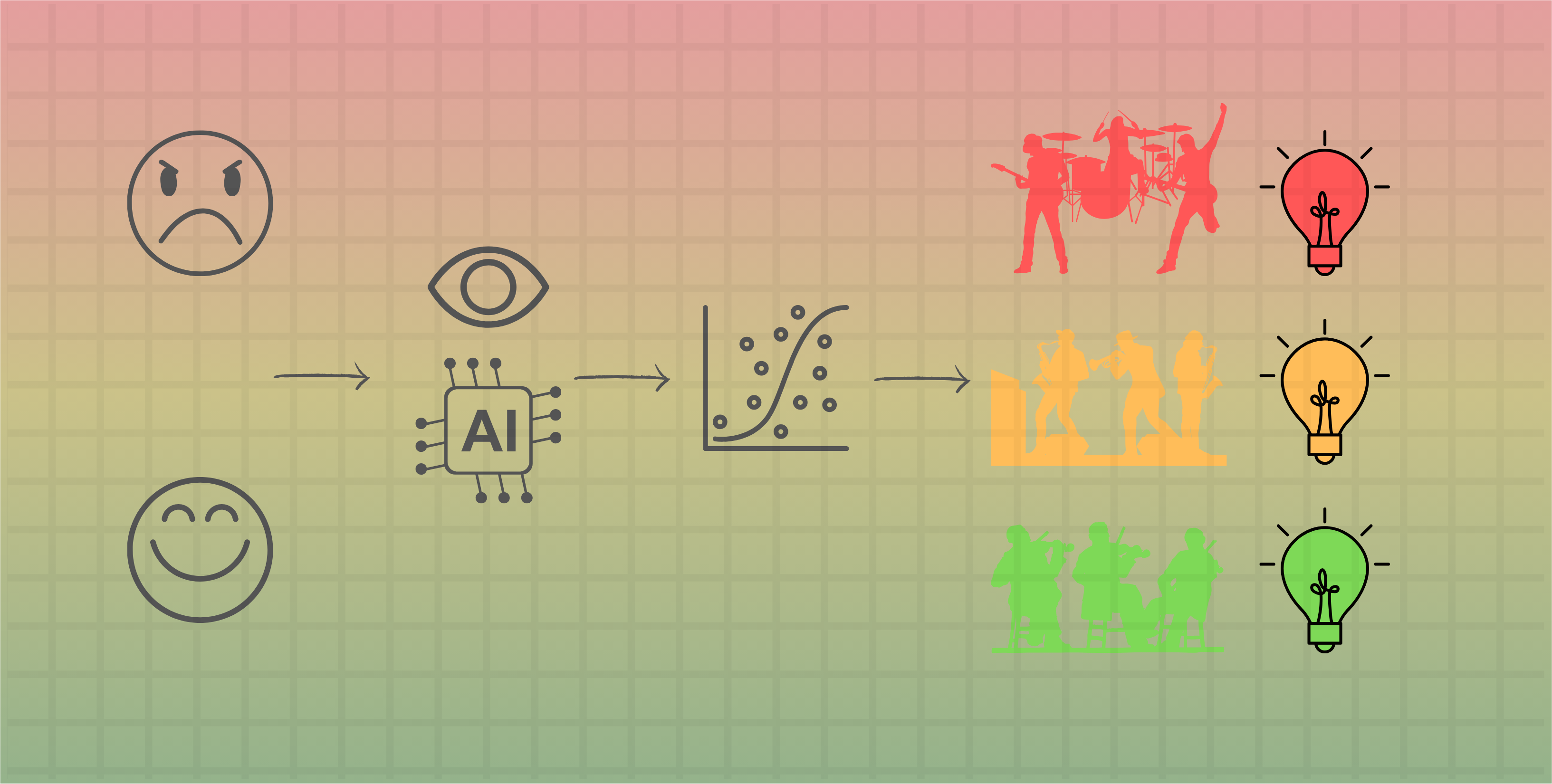
Pyna is a device that detects your mood and sets the right atmosphere through music, light, and potentially much more.
Project history
This project started as a three-day prototype for a hackathon about creating a mood reader.
We were all first-year bachelor students competing against older master students, but somehow, delightfully, we won. That gave us access
to a lab where we developed the idea for another six months.
We then showcased the prototype at Turin Maker Faire 2018, where it became a crowd favorite and earned us a booth at the much larger Maker Faire Rome 2018.
There, the project caught the attention of the press, who decided to interview us.
Project structure
The project had two main parts:
- locally, a Raspberry Pi with a camera and a speaker, enclosed in a 3D printed enclosure
- remotely, a private cloud server that handled API integrations and processing
The phases
- the user is in proximity of the pyna device
- the user’s face is detected by a face detection algorithm, running continuously on the raspberry pi
- a picture of the face is sent to the private cloud server
- the server asks a third party API to detect the user’s mood from the face picture
- the mood metric is used to select a light color
- the mood metric is processed, along with information about the user’s preferred music genre, to choose the correct music from Spotify
- requests are sent to Spotify API and Philips Hue API to set the correct song and light color
- The user mood is logged and displayed on a dashboard
Details
Each user can link their Spotify account and choose some favorite genres, which allows for customization: for somebody, happy songs might come from ACDC; for others, from Coldplay.
Songs are chosen from the whole Spotify catalogue, allowing for infinite choices, based on the preferred genres and a metric we
designed.
The device would activate randomly during the day to capture the user’s expression automatically and
discreetly, this should allow continuous and unbiased monitoring.
If the detected mood was good, the device would have an easy job of keeping the mood joyful.
If instead the mood was bad, the device would start by choosing “sadder” colors and music
(for example indigo light and Summertime Sadness from Lana Del Rey), slowly shifting to “happier” colours and more joyful music (like yellow light and MrBrightside from the Killers).
The idea was similar to walking alongside a friend who’s feeling bad: first you try to understand their mood, empathize with them, and then gently help them think of better things.
Disclaimer
Reading mood through vision alone may obviously be inaccurate in a real-life scenario, but for the hackathon it was what we had available.
Also, our ideas about improving someone’s mood were not based on psychology research, so please do not take them as serious advice :) .