On this page
The mission behind the companion
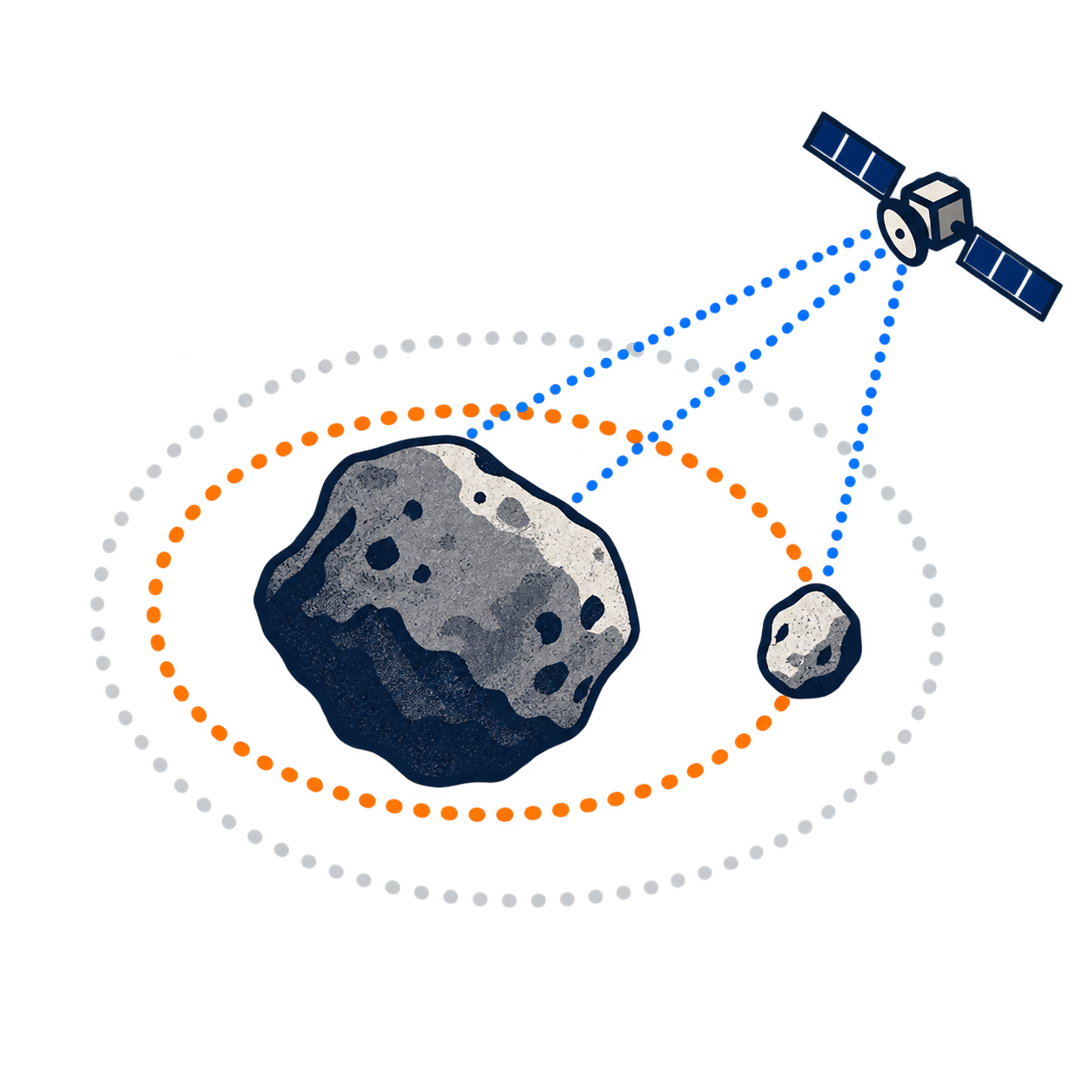
Didymos and Dimorphos are a pair of asteroids at the centre of the first full-scale test of asteroid deflection. NASA’s DART spacecraft deliberately struck Dimorphos and changed its orbit around Didymos, demonstrating that a kinetic impact could alter the path of an asteroid.
ESA’s Hera mission is travelling to the system to study what happened in detail. Its measurements will help turn one successful experiment into knowledge that future planetary-defence missions can use.
Making a distant mission feel personal
ESA also needed a way for people to understand and follow this mission. Terra Mater Studios proposed an AI companion: a digital Hera that could explain the science, tell the story, and invite each visitor into the crew.
Together with the company I work for, I built the complete digital experience for that companion. Open hera.esa.int and the mission immediately treats you as a participant. You receive a crew badge, then talk to Hera through text or voice instead of navigating a conventional collection of pages.
The conversation is the entrance, but the experience reaches much further. It brings together:
- near-live spacecraft telemetry;
- an explorable 3D model of Hera and its instruments;
- the spacecraft’s current orbital position;
- a simulation of the encounter with Didymos and Dimorphos;
- the scientists, engineers, and mission leads behind the work.
On 8 September, the companion was also used by an astronaut during a live connection from the International Space Station—an unusual moment in which the digital guide met the human reality of spaceflight.
One companion, many kinds of information
The central design problem was not simply adding a chatbot to a website. Hera had to connect live mission data, spatial interfaces, scientific explanations, and the people behind the mission without making any one of them feel like a separate product.
The AI companion gives those parts one voice and one relationship with the visitor. It can answer a question, direct attention to a spacecraft instrument, or make telemetry meaningful in the context of the journey. The result is a digital experience that behaves less like an archive and more like mission control with a guide beside you.
Hera with us
I developed this international project after returning to Presicce-Acquarica, the town in Salento where I grew up. That fact became the starting point for Hera with us, a local educational event for young people aged 11–14.
The event uses planetary defence, experiments, play, and the companion itself to make ambitious science tangible. It also carries a second message: a young person can come from a small town, remain connected to it, and still contribute to work with an international reach.
Book Hera with us ↗